Executive Overview
Television franchises rarely die a quiet death in the modern era; instead, they pivot, migrate, and occasionally mutate to find new life across platforms. Following an impressive eight-season run on CBS that cemented its status as a reliable procedural anchor, the S.W.A.T. universe is expanding—and relocating. Executive-produced by Jason Ning, the new sequel series S.W.A.T. Exiles has officially premiered on Starz, bringing with it the familiar star power of Shemar Moore while attempting to inject fresh blood into a tried-and-true formula.
Yet, the transition from network television to a premium cable and streaming network comes with inherent expectations of a paradigm shift. Audiences anticipated that breaking free from the strict censors of broadcast television would yield a grittier, morally complex, and uncompromisingly violent look at tactical law enforcement. However, early assessments of the premiere indicate a more conservative approach. S.W.A.T. Exiles occupies a peculiar middle ground—retaining the narrative architecture of its predecessor while introducing a heavily flawed, younger, and deeply unpolished new squad.
At the center of this new chapter is Daniel “Hondo” Harrelson (Shemar Moore), who finds himself thrust back into the tactical fray under duress, managing both an unruly band of rookies and an institutional conspiracy designed to ensure his failure. This report provides a comprehensive examination of the series premiere, analyzing its structural composition, character dynamics, thematic ambitions, and what this high-stakes relocation means for the longevity of the S.W.A.T. brand.
Detailed Chronology of the Premiere: From Private Security to Institutional Trap
The narrative architecture of S.W.A.T. Exiles wastes little time establishing the heavy toll that the past has exacted on its protagonist.
The Fall and The Re-Entry
The series opens with sweeping, cinematic vistas of downtown Los Angeles before abruptly cutting to the grim, disheveled interior of a messy apartment. The voice of Daniel “Hondo” Harrelson sets an introspective, world-weary tone: "People don’t fall all at once. It’s slower than that."
Two years have passed since Hondo willingly took the fall for a catastrophic, botched raid that resulted in the tragic death of a young S.W.A.T. officer. Exiled from the department and stripped of his badge, Hondo has spent the interim years scraping by in the private sector, providing high-end security for Silicon Valley tech elites ("tech bros").
The status quo is shattered when his former superior, Commander Robert Hicks (Patrick St. Esprit), re-enters his life with a mandate from the upper echelons of the LAPD: the department wants Hondo back. The catch? He is not returning to his old unit. Instead, he is tasked with building an entirely new S.W.A.T. team completely from the ground up.
Assembling the "Exiles"
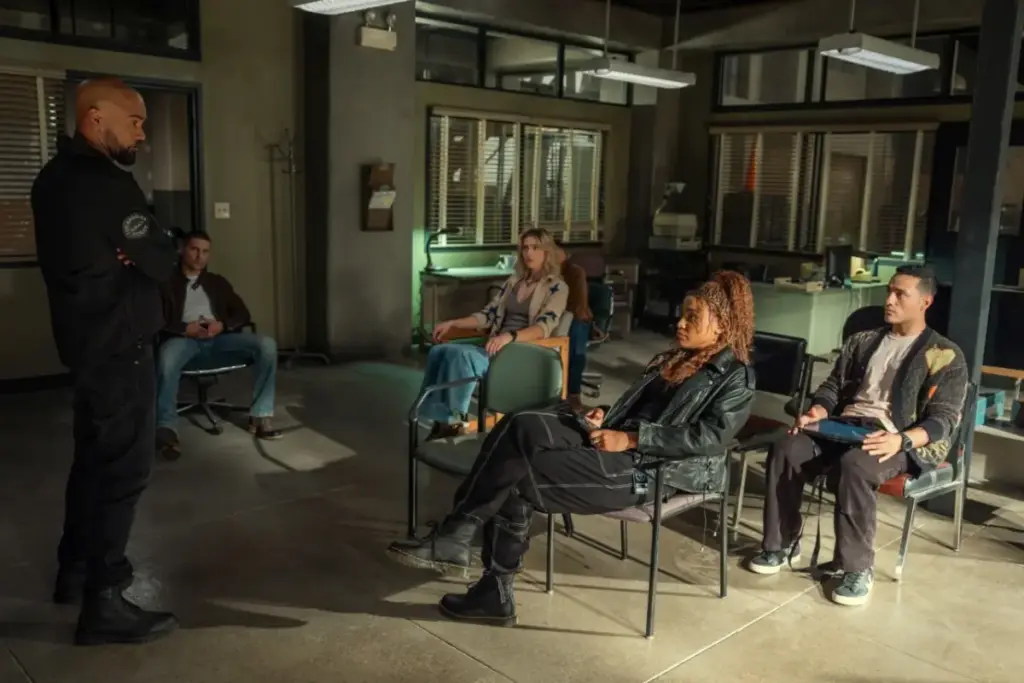
Upon taking the assignment, Hondo quickly realizes that his new squad is anything but a well-oiled tactical machine. Instead, he inherits a collection of misfits, specialists, and green recruits who lack both cohesion and seasoning:
- Sammy Bishop (Lucy Barrett): A terminally online, social-media-fluent Gen Zer whose compulsive documentation of her life creates tactical nightmares.
- Ethan Cole (Freddy Miyares): A socially awkward, hyper-intelligent drone specialist whose investigative tech skills push the boundaries of traditional S.W.A.T. protocols.
- Cassidy Han (Zyra Gorecki): A resilient operator who navigates the field with a prosthetic leg, frequently outmaneuvering and outperforming her able-bodied peers.
- Jude Reddick (Ronen Rubinstein): An operative harboring a complicated past and questionable loyalties.
- Malik Henderson (Adain Bradley): A fiercely independent rookie who does not hesitate to challenge Hondo’s authority and leadership motivations, especially after their initial training exercise goes disastrously wrong.
The Cartel Threat and The Setup
Despite the team’s glaring lack of synchronization, they are forced into active duty immediately. A high-stakes emergency arises when a former cartel assassin emerges from deep hiding to protect his threatened family.
As Hondo and his green recruits scramble to contain the violent escalation, a darker, more insidious plot is revealed. Hondo uncovers that the LAPD’s offer was never an act of redemption; rather, the department has deliberately set him up to fail. By saddling him with a dysfunctional squad and impossible parameters, the administration hopes to use his inevitable failure as a final justification to dismantle the S.W.A.T. division permanently.
The episode’s chilling parting shot pulls back the curtain even further: there is a mole embedded directly within Hondo’s new squad, deliberately working to ensure his destruction from the inside out.
Supporting Context & Metrics: The Shift from CBS to Starz
To truly understand S.W.A.T. Exiles, one must examine the operational and cultural shift from its origins on CBS to its current home on Starz.
The original S.W.A.T. series, which ran from 2017 to 2025 across eight seasons, was a textbook example of network television procedural durability. It relied on a reliable formula: high-octane action set pieces, a strong moral compass anchored by Shemar Moore’s charismatic performance, and closed-ended conflicts resolved within a tidy 42-minute broadcast window. Its cancellation—and subsequent revival attempts—highlighted the changing economics of network television, where streaming synergies and international licensing increasingly dictate a show’s lifespan.
When it was announced that the sequel series would land on Starz, industry analysts and fans alike projected a massive tonal evolution. Starz has built its brand on prestige, unrestrained adult content, moral ambiguity, and unapologetic grit—typified by gritty dramas like Power, BMF, and Outlander. Viewers expected Exiles to lean heavily into this aesthetic, shedding the broadcast restrictions that kept network TV heroes squeaky clean.
However, metric and content evaluations of the premiere reveal a surprising adherence to the status quo:
- Language and Content Adjustments: Moving to a premium platform resulted in minimal stylistic evolution. Aside from a handful of casual "shits" and a single, uncharacteristic F-bomb, the script operates within traditional basic-cable boundaries.
- Pacing and Structure: The narrative pacing remains structurally identical to the CBS era. Episodes adhere to the familiar rhythm of deployment, tactical entry, armed confrontation, and extraction, with little time dedicated to deep procedural forensics or slow-burn investigative journalism.
- Integration of Legacy Elements: While establishing a new identity, the production wisely maintains ties to the original series to comfort returning fans. Alongside Moore and Patrick St. Esprit, the premiere features a poignant guest appearance by original series star Jay Harrington, reprising his role as Deacon, providing a vital bridge between the old guard and the new era.
Performance Analysis & Character Breakdown
The beating heart of S.W.A.T. Exiles—much like its predecessor—remains the commanding screen presence of Shemar Moore.
Shemar Moore as Hondo: The Anchor
Moore effortlessly commands nearly every frame he inhabits. Even when the dialogue dips into bafflingly simplistic tactical advice (such as his insistence that a "clean entry" will inherently make everything else flow smoothly), Moore infuses Hondo with a weathered, empathetic gravitas. He wears the exhaustion of an institutional scapegoat well, making his paternal, authoritative dynamic with the new recruits the most engaging element of the premiere.
The Supporting Cast: Room for Growth and Missteps
The surrounding ensemble presents a mixed bag of compelling concepts and questionable execution:
- Lucy Barrett’s Sammy Bishop: The writers tread a fine line with Bishop. Having a tactical officer wander around an active operational zone while recording a live stream feels like a glaring violation of operational security that strains viewer suspension of disbelief. Yet, out of all the new recruits, Barrett’s character arguably carries the most room for organic narrative growth, serving as a commentary on the hyper-connected, validation-seeking modern generation thrust into high-trauma environments.
- Freddy Miyares’ Ethan Cole: Cole introduces a tech-centric investigative element that feels slightly out of alignment with traditional S.W.A.T. mythos. While contemporary law enforcement heavily utilizes digital forensics, the show occasionally struggles to balance high-speed room-clearing with high-tech desk work.
- Adain Bradley’s Malik Henderson: Henderson functions effectively as the primary internal antagonist to Hondo’s leadership, establishing a tense, friction-filled dynamic that prevents the team from becoming too harmonious too quickly.
Future Outlook: Can Exiles Sustain Its Premise?
As S.W.A.T. Exiles maps out its maiden season on Starz, it faces a distinct identity crisis. By choosing to replicate the formula of an eight-season network procedural rather than leaning into the gritty, serialization-heavy freedom of a premium streaming platform, the series risks alienating viewers who tuned in expecting a radical evolution.
Conversely, for die-hard fans of the original CBS run who simply wanted more adventures with Hondo at the helm, Exiles delivers a comforting, if generic, continuation. The introduction of the internal mole conspiracy and the LAPD’s systemic sabotage provide a serialized narrative spine that could elevate the show beyond standard "case-of-the-week" television—provided the writers are willing to let the consequences of institutional corruption truly bite.
Ultimately, S.W.A.T. Exiles proves that you can take the tactical team out of network television, but erasing the muscle memory of a long-running procedural is a much harder breach to clear. Whether Hondo’s new squad can survive both the cartel threats on the streets and the bureaucratic assassins within the precinct will determine if this spin-off carves out a permanent home on Starz or remains a fleeting footnote in the franchise’s history.