The intersection of artificial intelligence and traditional craftsmanship has reached a volatile flashpoint in Bristol, a city internationally renowned as a crucible of counter-cultural street art and the clandestine birthplace of Banksy. A newly unveiled, large-scale vinyl mural plastered across the exterior wall of the Jolly Colliers pub in the South Bristol district of Bedminster has triggered swift and severe backlash from the local creative community. Far from celebrating the city’s rich artistic heritage, the installation has been lambasted as a "slap in the face" to working artists, an overt promotion of intellectual property theft, and an aesthetic catastrophe riddled with glaring geographic and historical inaccuracies.
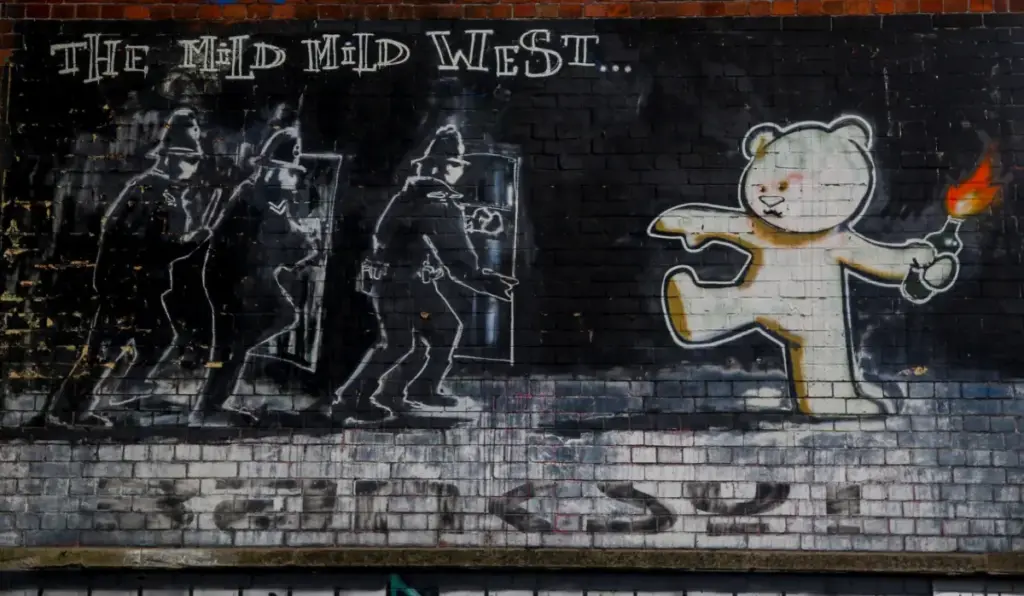
The mural—subsequently printed as a massive vinyl wrap and pasted directly onto the building’s facade—was seemingly generated via generative AI tools. Rather than capturing the authentic grit, cultural nuance, and architectural majesty of Bristol, the algorithmic creation produced a bizarre pastiche of local landmarks. Among its most ridiculed errors are a heavily distorted, unrecognizable interpretation of Cabot Tower, an iconic local landmark; a depiction of the historic SS Great Britain that resembles a modest steam-powered tugboat rather than the majestic ocean liner that once dominated maritime history; and a bungled rendition of Banksy’s famed 1999 stencil Mild Mild West. Instead of featuring the artist’s legendary, defiant teddy bear hurling a Molotov cocktail, the AI hallucinated a one-legged figure pointing aimlessly.
This incident has amplified broader national anxieties regarding the encroachment of machine learning into creative industries. For Bristol, a city that proudly plays host to Upfest—Europe’s largest street art festival—the installation is viewed as more than a mere design blunder. Local creatives argue it represents a dangerous cultural endorsement of algorithmic shortcuts at the expense of human livelihood, community heritage, and genuine artistic integrity.
Detailed Chronology of the Controversy
The unfolding controversy surrounding the Jolly Colliers pub mural developed rapidly over the course of several days, transforming a localized property management decision into a high-profile public debate concerning the ethics of AI in public spaces.
The Unveiling and Immediate Backlash
The controversy began when the massive street artwork was erected on the side of the Jolly Colliers pub on West Street in Bedminster. Almost immediately, eagle-eyed pedestrians, local residents, and members of the city’s tight-knit graffiti and muralist community noticed something was deeply amiss. The panoramic collage of Bristol imagery bore the unmistakable hallmarks of generative AI: weirdly warped architectural lines, nonsensical object proportions, and a profound misunderstanding of local culture.
Social media platforms and local forums lit up with criticism within hours of the installation. Artists and historians alike pointed out the staggering volume of errors packed into a single display. The distortion of the SS Great Britain—transforming Isambard Kingdom Brunel’s revolutionary iron-hulled passenger steamship into a generic, squat tugboat—was particularly galling to local historians. Meanwhile, the mangled pastiche of Banksy’s Mild Mild West crossed the line from poor pastiche into outright absurdity, replacing the unmistakable anti-authoritarian imagery with a faceless, anatomically confused surrogate.
The Anonymous Protest and Ephemeral Letter
As public anger mounted, physical resistance manifested directly beneath the disputed artwork. On Tuesday, an anonymous letter penned by a local artist was pinned to the base of the mural. The manifesto did not mince words, condemning the pub’s choice as a "disrespectful affront to this city."

The letter articulated the collective fury of Bristol’s creative scene:
"By choosing to ‘create’ (though that word gives more credit than is due) an AI-generated image, produce it in vinyl and stick it to the side of your building, you are actively damaging the livelihoods of artists, disrespecting and contributing to the theft of their work, and making a mockery of what makes Bristol the city it is. You have watered down the spirit, the originality and the very essence of the visual aesthetic you have tried, and failed, to recreate."
Although the impassioned missive was swiftly removed from the premises, its contents had already been widely photographed and circulated, cementing the community’s refusal to let the installation pass without a challenge.
The Institutional Response
As pressure mounted from local collectives, independent artists, and digital commentators alike, Punch Pubs—the corporate entity that owns the Bedminster establishment—issued a formal public statement attempting to defuse the escalating situation. According to the company’s spokesperson, the vinyl installation was never intended to be a permanent artistic statement. Instead, they framed it as a temporary measure necessitated by the poor physical condition of the building’s exterior wall.
The corporate spokesperson stated:
"The external wall requires some minor works which would make a permanent mural at this time difficult, so we have opted for a temporary solution."
Furthermore, Punch Pubs sought to extend an olive branch to the alienated community, stating that they are actively looking forward to collaborating with local artists and the wider neighborhood in the near future to commission and install a genuine, permanent mural once the structural maintenance is completed.

Supporting Context & Metrics: Bristol’s Creative Economy Under Threat
To fully understand why the Jolly Colliers mural sparked such visceral outrage, one must examine Bristol’s unique cultural ecosystem. Often styled as the unofficial street art capital of the United Kingdom, Bristol’s identity is inextricably bound to the sweat, paint, and political defiance of human creators.
The Epicenter of Street Culture
Bristol’s streets function as an open-air gallery, drawing millions of global tourists annually to view works by legendary figures such as Banksy, Nick Walker, and Inkie. The city is also home to Upfest, Europe’s largest live street art and graffiti festival, which draws hundreds of international artists to paint large-scale murals across South Bristol every year. This vibrant economy of public art relies entirely on human labor, physical endurance, technical mastery, and deeply personal socio-political commentary.
When a commercial establishment opts for an AI-generated vinyl print—manufactured cheaply via algorithms trained on scraped intellectual property—it strikes directly at the economic foundation of this community.
Voices from the Bristol Mural Collective (BMC)
Prominent local artists and representatives from the Bristol Mural Collective (BMC) have been vocal in their condemnation, framing the incident as a critical political battleground for the future of creative labor.
Caroline Maggs of the BMC did not hold back in her assessment, telling local media outlets:
"AI designs not only devalue but undermine the work of artists… We are small businesses, and as a small business themselves, they should have chosen better. In a climate where humans are being replaced by AI at an alarming rate, choosing art like this is not only an aesthetic choice but a political one."
Maggs went as far as to suggest that having a blank, decaying wall would have been preferable to displaying algorithmic art, noting that the collective remains open to discussions with the pub’s management to rectify the mistake with an authentic, hand-painted commission.

Emily Tuffen, another prominent artist within the BMC, highlighted the broader existential threat posed by normalized AI usage in public spaces. Describing the mural as a "slap in the face" to the city, Tuffen remarked:
"Brunel would be turning in his grave over the piece… The mural is like a giant green light telling all of south Bristol (and anyone who views it online) — AI is fine, let’s jump in feet first! Tally ho! I don’t think it will last long, one way or the other. Bristol won’t stand for it."
Tuffen also offered a satirical proposal to salvage the situation:
"On a personal level, I would be so happy if someone circled all the mistakes in red paint like a teacher or a spot the difference puzzle. That would make it actually a good street art piece and a clear statement. Bristol loves authentic creativity and won’t stand for intellectual property theft!"
Echoing these sentiments, fellow artist Nina Raines dismissed the piece as "visually naff," while Fiona Finn Teo labeled it "an appalling and tone-deaf display of absolute nonchalance and disregard to artists residing in Bristol and beyond."
Official Statements and Corporate Defense
The controversy surrounding the Jolly Colliers highlights a growing corporate dissonance: the desire to leverage the cultural cachet and aesthetic appeal of "street art culture" without paying the financial and logistical costs required to support authentic creators.
Punch Pubs’ defense—that the vinyl wrap was merely a utilitarian shield for a crumbling exterior wall—has done little to appease critics who point out that even temporary art carries a cultural message. By choosing a zero-cost, algorithmically generated image over a community-sourced canvas, the property owners inadvertently signaled that convenience trumps community engagement.

While the corporate spokesperson’s promise of a future collaboration offers a glimmer of hope for a resolution, trust has been severely fractured. The speed with which the community mobilized demonstrates that Bristol’s artists are hyper-vigilant against the creeping normalization of generative AI in public domains. For a city built on rebellious authenticity, automated art is viewed not as innovation, but as cultural vandalism.
Future Outlook: The Battle Lines for Public Art
As the debate over the Jolly Colliers mural cools into negotiations for a permanent replacement, the incident serves as a bellwether for towns and cities across the globe. As generative AI tools become cheaper, faster, and more accessible, property owners, local councils, and commercial entities will increasingly face the temptation to bypass human artists in favor of algorithmic efficiency.
However, the fierce pushback in Bedminster proves that local communities possess strong immune systems against cultural synthetic substitution. Public art is fundamentally about human connection, shared heritage, and localized storytelling—elements that algorithms inherently lack, as evidenced by the absurd mishmash of tugboats, warped towers, and mutated teddy bears adorning West Street.
Whether Punch Pubs will successfully mend fences by commissioning a genuine, hand-painted mural from the Bristol Mural Collective remains to be seen. What is certain, however, is that Bristol has drawn a definitive line in the concrete: the birthplace of modern street art will not quietly yield its walls to the machine age.